[Mabu Valley Gear Journal] How to Choose Emergency Rations? NRG-5 and NRG-5 ZERO Emergency Rations Explained
How do you choose emergency food rations? When preparing earthquake kits, typhoon supplies, car emergency gear, or planning for outdoor activities, the most important thing isn't just stocking up on "food." You need to prepare emergency rations that are long-lasting, require no cooking, are easy to portion out, and can quickly replenish calories.
Many people stock their emergency kits with instant noodles, biscuits, canned goods, or snacks, but these aren't always suitable when you are truly faced with water outages, power outages, evacuation, or interrupted supplies. Instant noodles require hot water, canned goods are heavy, and snacks have a limited shelf life and may not provide stable energy.
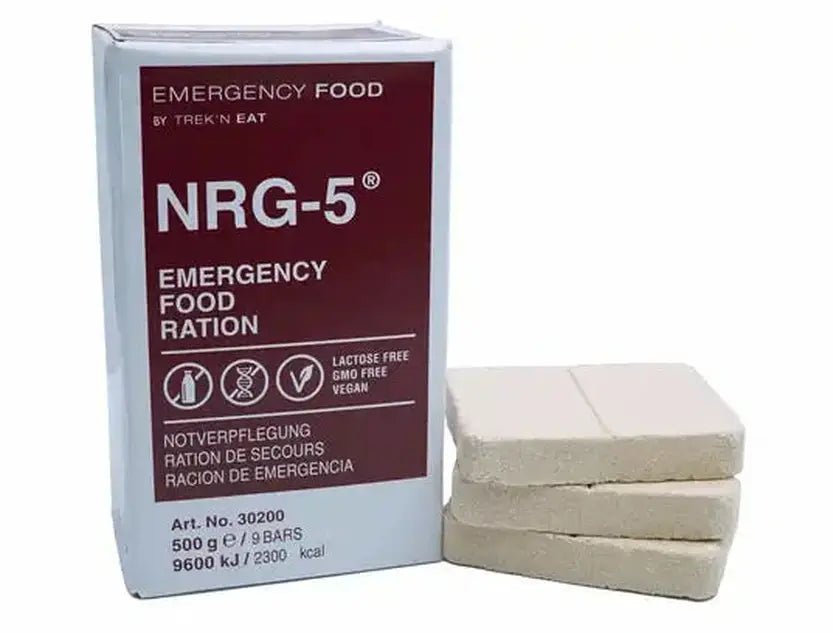
NRG-5 and NRG-5 ZERO are German-made emergency food rations designed for disaster preparedness, outdoor activities, and emergency response.
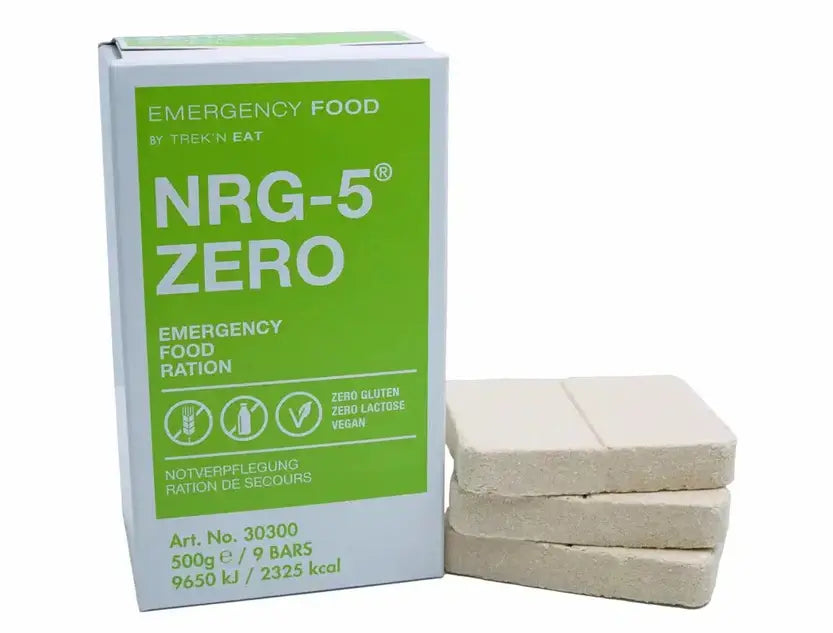
Both come in 500g packages containing 9 compressed bars. They can be eaten directly, or crushed and mixed with water to create a porridge or a thinner paste. The difference is: NRG-5 is designed for a 20-year shelf life, while NRG-5 ZERO is rice-based, gluten-free, lactose-free, and vegan, making it suitable for a wider range of dietary needs.
A 30-second guide to NRG-5 and NRG-5 ZERO emergency rations
- Product positioning: German-made emergency rations, suitable for disaster preparedness, earthquake kits, typhoon supplies, outdoor activities, and emergency response.
- Preparation: Can be eaten directly, or crushed and mixed with water to create a porridge/paste.
- Single pack contents: 500 g, containing 9 bars, approximately 55.5 g per bar.
- Caloric content: NRG-5 approx. 2300 kcal; NRG-5 ZERO approx. 2325 kcal.
- Shelf life: NRG-5 up to approx. 20 years; NRG-5 ZERO up to approx. 15 years.
- Formula differences: NRG-5 is wheat-based; NRG-5 ZERO is rice-based, gluten-free, lactose-free, and vegan.
- Usage tips: Please choose based on personal allergies, dietary restrictions, and physical condition, and consume with adequate drinking water.
Why shouldn't you rely only on instant noodles and biscuits for disaster preparedness?
Disaster preparation isn't just about putting food into a bag; it requires considering "long-term shelf life," "need for cooking," "ease of portioning," and "reasonable weight and volume."
During power outages, water cuts, or evacuations, gas stoves, hot water, utensils, and cooking time can all become constraints. In such cases, emergency rations that can be eaten directly become crucial.
The design focus of NRG-5 and NRG-5 ZERO is to provide a stable source of calories in situations with limited resources. They require no heating, cooking, can openers, or extra tools. Once opened, they can be eaten immediately or, depending on available drinking water, crushed and added to water to make a paste that is easier to swallow.
This makes them suitable not only for hiking or camping but also for household disaster kits, earthquake bags, typhoon preparedness, car emergency supplies, warehouse storage, disaster relief missions, and government contingency supplies.
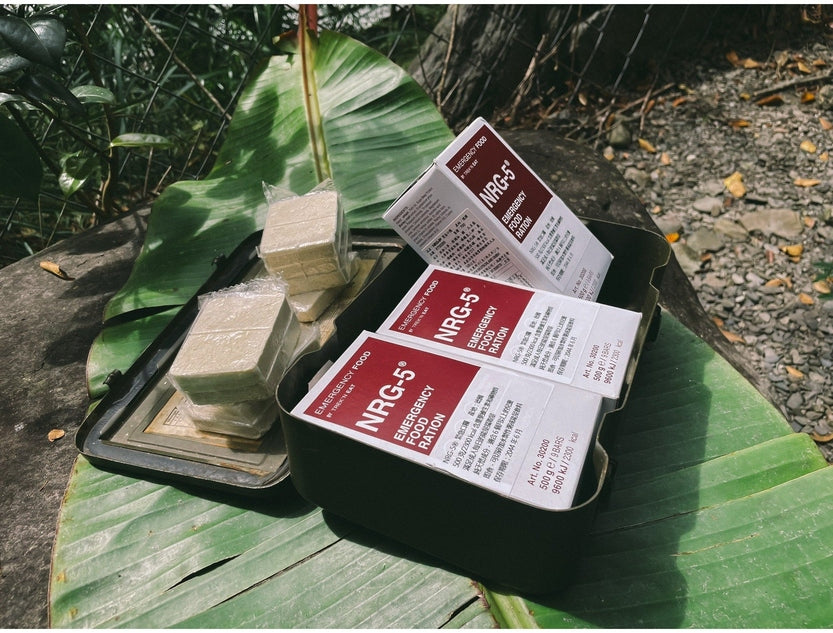
NRG-5: 20-year long-term shelf-life food, suitable for standard disaster preparedness
NRG-5 is a classic emergency ration featuring a wheat-based formula. Each 500g package contains 9 bars with a total of approximately 2300 kcal, which can serve as a high-calorie supplement in emergency situations; actual needs will vary depending on age, body size, activity level, and health status.
Its strength lies in long-term shelf life and stable caloric supply. The manufacturer specifies that NRG-5 is lactose-free, non-GMO, and vegan, and it contains various vitamins and minerals. The Mabu Valley product page currently indicates a shelf life of 20 years, making it suitable for long-term storage in homes, offices, cars, or disaster storage facilities.
NRG-5 can be eaten directly, and its texture is relatively easier to consume than traditional hard compressed biscuits. For the elderly, those with weaker teeth, or those finding it difficult to chew dry food in an emergency, the rations can also be crushed and mixed with water to create a porridge or drinkable form.
Selection tip: If your primary goal is long-term disaster preparedness, household storage, or unit warehousing, and you have no gluten allergies or specific dietary restrictions, NRG-5 is the most straightforward, standard choice.
NRG-5 ZERO: Gluten-free emergency rations for specific dietary needs
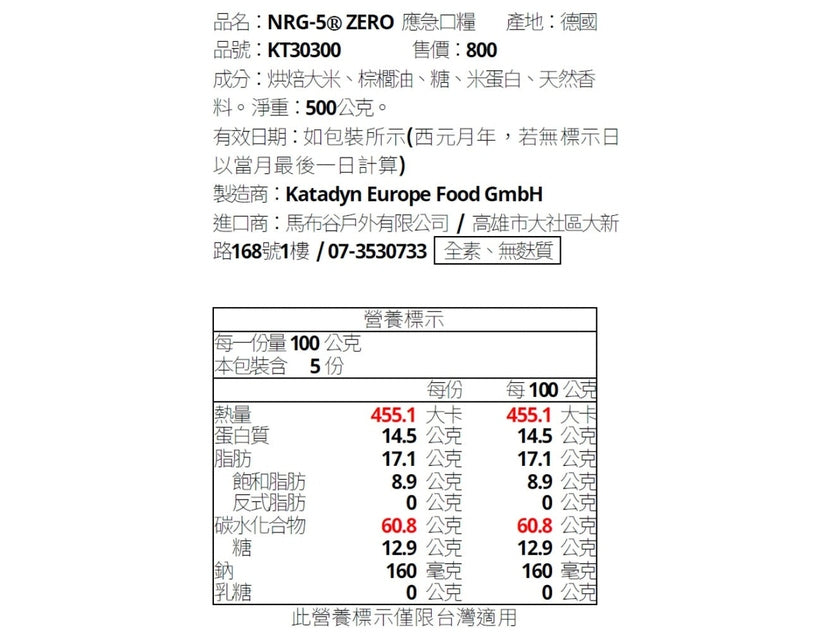
NRG-5 ZERO is also a German-made emergency ration, with a 500g package containing 9 bars and a total of approximately 2325 kcal. The main difference from the standard NRG-5 is its rice-based formula, which is labeled gluten-free, lactose-free, and vegan.
For individuals with gluten sensitivity, lactose intolerance, or those needing simpler ingredients, NRG-5 ZERO is a more suitable option than the standard version. Its ingredients are primarily based on baked rice, palm oil, sugar, rice protein, and natural flavorings.
In terms of shelf life, NRG-5 ZERO lasts up to approximately 15 years. While shorter than the 20 years of the standard NRG-5, it remains a very long shelf life for most household disaster preparedness and outdoor planning.
Selection tip: If anyone in your household requires gluten-free, lactose-free, or vegan food, or if you want your emergency kit to cater to diverse dietary needs, NRG-5 ZERO is the more flexible choice.
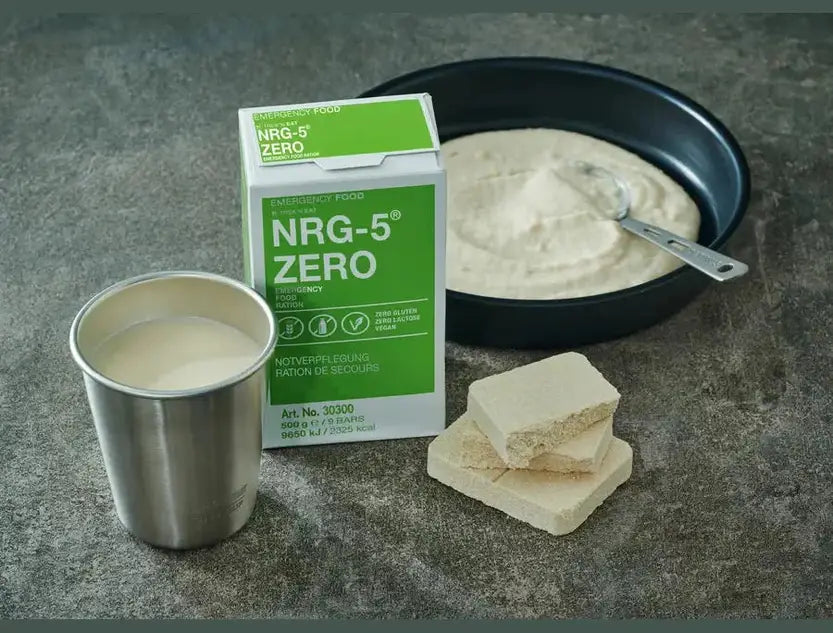
Comparison between NRG-5 and NRG-5 ZERO emergency rations
| Item | NRG-5 | NRG-5 ZERO |
|---|---|---|
| Base Ingredient | Wheat base | Rice base |
| Weight per Pack | 500 g, contains 9 bars | 500 g, contains 9 bars |
| Total Calories | Approx. 2300 kcal | Approx. 2325 kcal |
| Shelf Life | Up to approx. 20 years | Up to approx. 15 years |
| Dietary Profile | Lactose-free, non-GMO, vegan | Gluten-free, lactose-free, vegan |
| Target Audience | General household disaster preparedness, earthquake bags, typhoon supplies, long-term unit storage | Those requiring gluten-free, lactose-free, or special dietary options |
In short, NRG-5 is the standard model with priority on long-term shelf life; NRG-5 ZERO is the special formula model designed to accommodate dietary restrictions and allergies.
How much should you prepare for earthquake and typhoon supplies?
There is no single answer to how much emergency food you should prepare. It is recommended to plan based on the "number of people," "number of days," "water consumption," and "whether there are special dietary needs."
Household disaster kits can be planned based on the number of residents, individual requirements, and the latest government disaster prevention guidelines, supplemented with drinking water, electrolyte supplies, canned goods, dried food, and regular medications. If the household includes elderly people, infants, pregnant women, patients with chronic diseases, or those with special dietary needs, you need to separately assess chewing ability, gluten/lactose requirements, or specific allergens.
The benefits of NRG-5 and NRG-5 ZERO are their clear caloric content per pack, relatively small volume, long shelf life, and ease of storage in earthquake kits, cars, office drawers, or emergency storage bins.
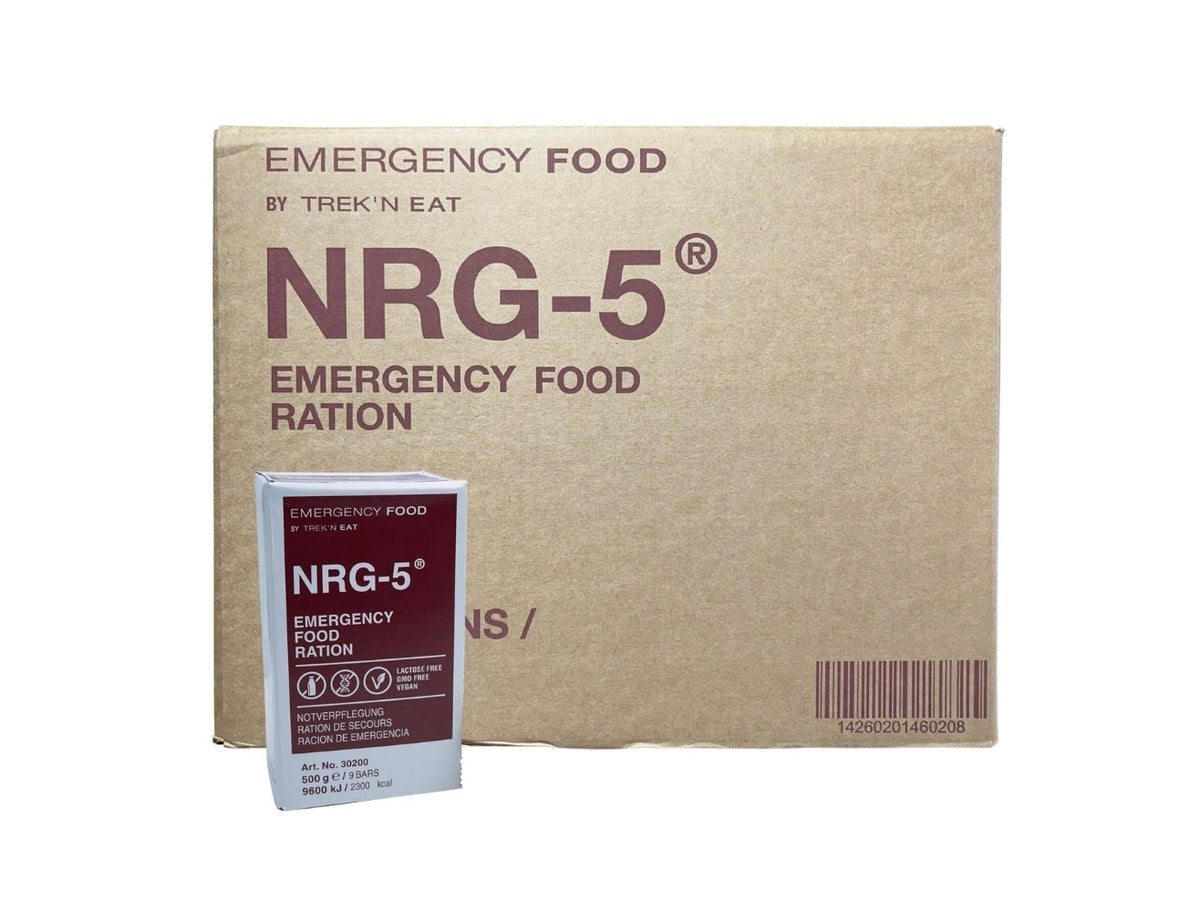
For household, corporate, business, community, or unit procurement, besides preparing individual boxes, consider buying by the case to establish a fixed stock. A case of 24 boxes of NRG-5 is more suitable for long-term storage, warehouse supplies, group activities, and unit contingencies, and makes it easier to regularly check expiration dates and inventory levels.
How to eat them? Eat directly or add water to make a paste
Neither NRG-5 nor NRG-5 ZERO requires heating or cooking; they can be eaten directly upon opening. This is crucial in emergencies, as you may not have gas, electricity, cooking utensils, or hot water.
If you prefer a softer texture, you can crush the bars and add a suitable amount of drinking water to create a porridge-like consistency; by adding more water, you can make a thinner, easier-to-swallow paste. This method is suitable for the elderly, those with weaker teeth, or those who have difficulty chewing dry food under stressful situations.
For children, it is recommended that an adult adjust the texture by crushing and adding water according to the child's chewing and swallowing ability and care needs, while also confirming that the ingredients and allergens are suitable.
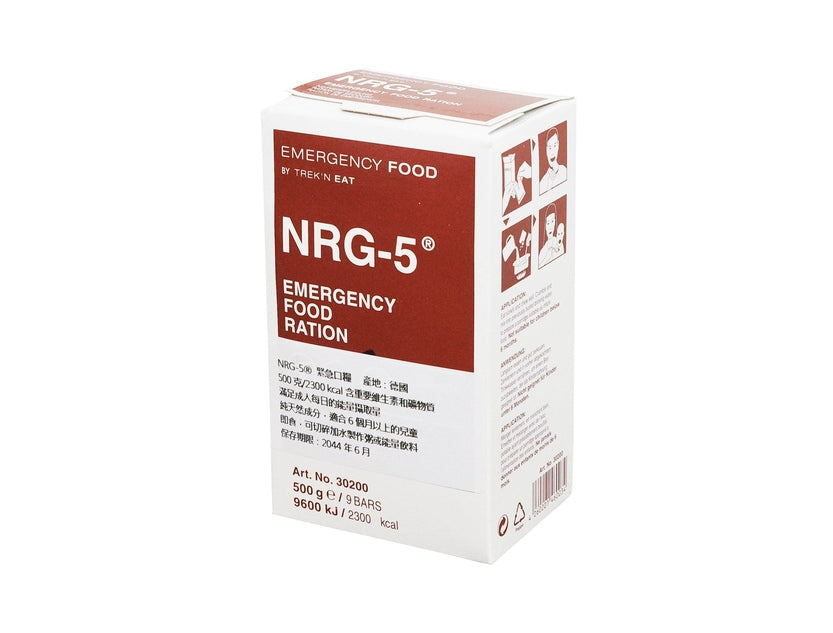
Long-term storage food: How is it different from regular snacks?
Common biscuits, chocolate, energy bars, or snacks can be stored in emergency kits for the short term, but they usually have a shorter shelf life and are easily affected by high temperatures, humidity, fat oxidation, or packaging damage.
NRG-5 and NRG-5 ZERO are not positioned as daily snacks, but as long-term storage food. Their focus is on shelf life, caloric density, convenience of portioning, and usability in emergencies.
In other words, snacks can provide peace of mind in an emergency kit, but emergency rations are the stable source of energy. The two can be used in combination, but relying solely on common snacks as primary disaster supply is not recommended.
Outdoors and Travel: More stable backup energy than snacks
For mountaineering, camping, car camping, long-distance travel, or moving through remote areas, NRG-5 and NRG-5 ZERO can also be used as "backup energy."
Unlike regular snacks, they are not easily affected by taste preferences, temperature, or shelf life, and they do not require cooking. When schedules are delayed, supply points are closed, weather turns bad, or physical strength wanes, a package of rations that has a long shelf life, is easily portioned, and has clear caloric value can reduce a lot of uncertainty.
It might not be the food you most want to eat every day, but it is the backup you hope is always in your emergency kit or gear bag.
Usage reminder: Emergency rations are not a substitute for a daily diet
NRG-5 and NRG-5 ZERO are high-calorie rations designed for emergency and contingency scenarios and should not replace a balanced daily diet in the long term.
Before purchasing, it is recommended to check the ingredients and allergens. NRG-5 is wheat-based and contains soy protein; if you have gluten allergies, wheat allergies, or soy-related allergies, you should avoid it or choose a more suitable alternative. NRG-5 ZERO is rice-based and gluten-free, but it is still recommended to check the actual labeling to ensure it meets your individual needs.
Store in a cool, dry place away from direct sunlight, high heat, humidity, or damaged packaging. Do not consume if the packaging is inflated, torn, damp, or smells unusual.
Who should prepare NRG-5 emergency rations?
NRG-5 and NRG-5 ZERO are highly suitable for the following users and organizations:
- For household disaster preparedness, typhoon seasons, earthquake preparedness, and power/water outage emergencies.
- For earthquake kits, car emergency gear, offices, storefronts, warehouses, and community relief supplies.
- For mountaineering, camping, car camping, long-distance travel, and remote area itineraries.
- For disaster relief, civil defense, outdoor education, search and rescue, and group contingency needs.
- For those requiring long-term storage, quick portioning, no-cook, high-calorie supplies.
- For those needing gluten-free, lactose-free, or vegan emergency supplies, NRG-5 ZERO should be the priority.
How to combine emergency rations for better practicality?
You can position NRG-5 and NRG-5 ZERO as "disaster and outdoor contingency first" emergency rations.
They are not intended to replace daily meals, nor are they snacks meant for taste variety; they provide stable calories and predictable shelf life when resources, time, and tools are limited.
If you are building a household disaster kit, NRG-5 is suitable as the standard for long-term storage; if you hope your supplies can accommodate different body types, dietary restrictions, or gluten sensitivity needs, NRG-5 ZERO will be a great complement.
Truly practical emergency rations should be easy to store, easy to take, easy to portion, and easy to eat. The value of the NRG-5 series lies in its integration of these requirements into a compact, durable, and ready-to-eat package.
Conclusion: Prepare your emergency rations, and find real peace of mind
When we have convenient stores, restaurants, and food delivery, we rarely realize how important food supply is. But when faced with a disaster, power outage, transportation interruption, or unexpected outdoor situation, having stable, instantly accessible calories becomes a critical resource.
NRG-5 and NRG-5 ZERO are not meant to make daily eating exciting, but to provide a simple, reliable, and easily stored contingency option for uncertain situations.
Disaster preparedness doesn't need to be perfect at once, but you can start with a package of emergency rations that can be stored long-term and eaten directly.
[[Related Products]]
To learn more about NRG-5 and NRG-5 ZERO emergency rations, or if you need assistance in planning your household disaster preparedness, earthquake bags, typhoon supplies, or unit reserves, please feel free to contact us via the Mabu Valley official LINE.
Learn more about the brand
If you would like a deeper understanding of the brand background, product philosophy, and complete product line, you can also refer to the brand website.