Operation Blessing Colombia Refugee Water Supply Case Study | Dual System Deployment with KATADYN and SPECTRA
When large numbers of refugees arrived at the Colombian border, the camps needed water filtration tools that could be immediately distributed to families, as well as mobile water purification equipment capable of supporting larger populations.
Operation Blessing deployed two solutions based on the scale of water supply: KATADYN First Response Gravity Filters for household-level filtration and SPECTRA Universal Aquifer 360, a solar-powered system, to handle larger daily water demands.

案例原始資料|Original Case Information
邊境現場的雙重需求|The Challenge
The crisis in Venezuela and Colombia displaced a large number of residents from their homes, placing immense pressure on remote border crossings and temporary camps regarding drinking water, sanitation, and medical care. While bottled water can be delivered quickly, it continuously occupies transportation capacity and cannot solely form a long-term supply.
Operation Blessing therefore needed two different scales of tools: one that could be operated directly by families, and another that could centrally produce more drinking water to support camps and service points.

家戶過濾與集中造水|The Solution
KATADYN First Response Gravity Filters
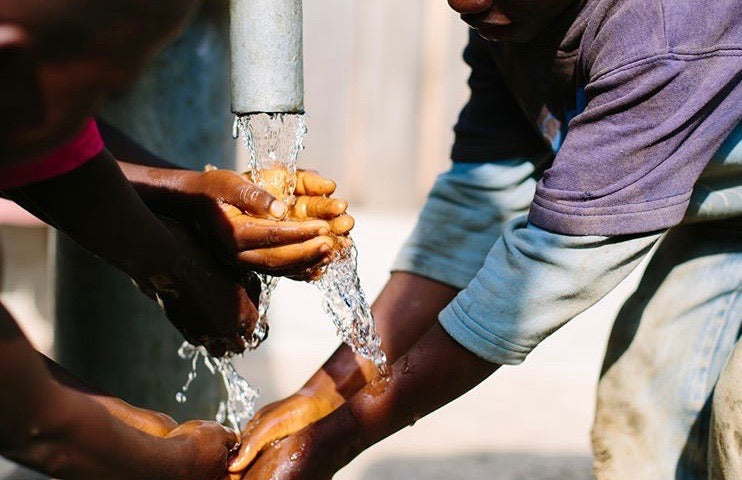
Gravity filters were directly distributed to refugee families. These devices do not require electricity and can process daily drinking water in camps and temporary living spaces, eliminating the need for families to wait for centralized distribution each time.
SPECTRA Universal Aquifer 360
The Aquifer 360 is used for larger-scale water supply needs. The original case indicates that it can process fresh, brackish, and seawater, with a maximum daily output of approximately 360 gallons. It also includes 3 solar panels, allowing it to operate in environments without stable grid power.
The entire system is stored in three military-grade protective cases and can be transported as checked baggage on commercial flights. According to the manufacturer's calculations based on water output, the daily production capacity exceeds that of a pallet of bottled water, yet it can continuously produce drinking water on-site, reducing the pressure of daily resupply.
Learn more about KATADYN BeFree 3.0L Gravity Filter
Learn more about SPECTRA Aquifer 360 Mobile Watermaker System

同一個營地,不同規模的供水|Project Outcome
This case did not rely on a single piece of equipment to meet all needs, but rather deployed a tiered system based on the scale of use for families and camps. Household filters reduced waiting times for water collection, while the Aquifer 360 established a centralized production capacity. Together, both reduced reliance on bottled water transportation.
Mabu Valley's Take
The most effective humanitarian water supply configuration often involves establishing different levels based on users, distribution distance, and supply volume, rather than simply choosing the largest single piece of equipment.
Families can process small amounts of drinking water themselves, while a centralized system handles larger production volumes. This combination enhances the camp's water supply flexibility when transportation is limited.
When planning shelters, post-disaster sites, or cross-regional support, it is essential to assess raw water sources, population distribution, daily water demand, distribution routes, energy sources, operators, and consumable resupply, and then determine the proportion of household, group, and centralized water purification equipment.